EMOTE: Quantification of Facial Asymmetries using Inaudible Acoustic Sensing on Smart Glasses
Published in ACM Transactions on Computing for Healthcare (ACM HEALTH), 2026
Recommended citation: Ke Li, Roy Xiao, Elizabeth McGonagle, Pieter Boek, James Heaton, Tessa Hadlock, and Cheng Zhang. 2026. EMOTE: Quantification of Facial Asymmetries using Inaudible Acoustic Sensing on Smart Glasses. ACM Trans. Comput. Healthcare (Just Accepted). https://doi.org/10.1145/3864024
Keyword: Ubiquitous Computing, Smart Glasses, Acoustic Sensing, Deep Learning, Facial Landmarks, Facial Asymmetry Quantification, eFACE Score

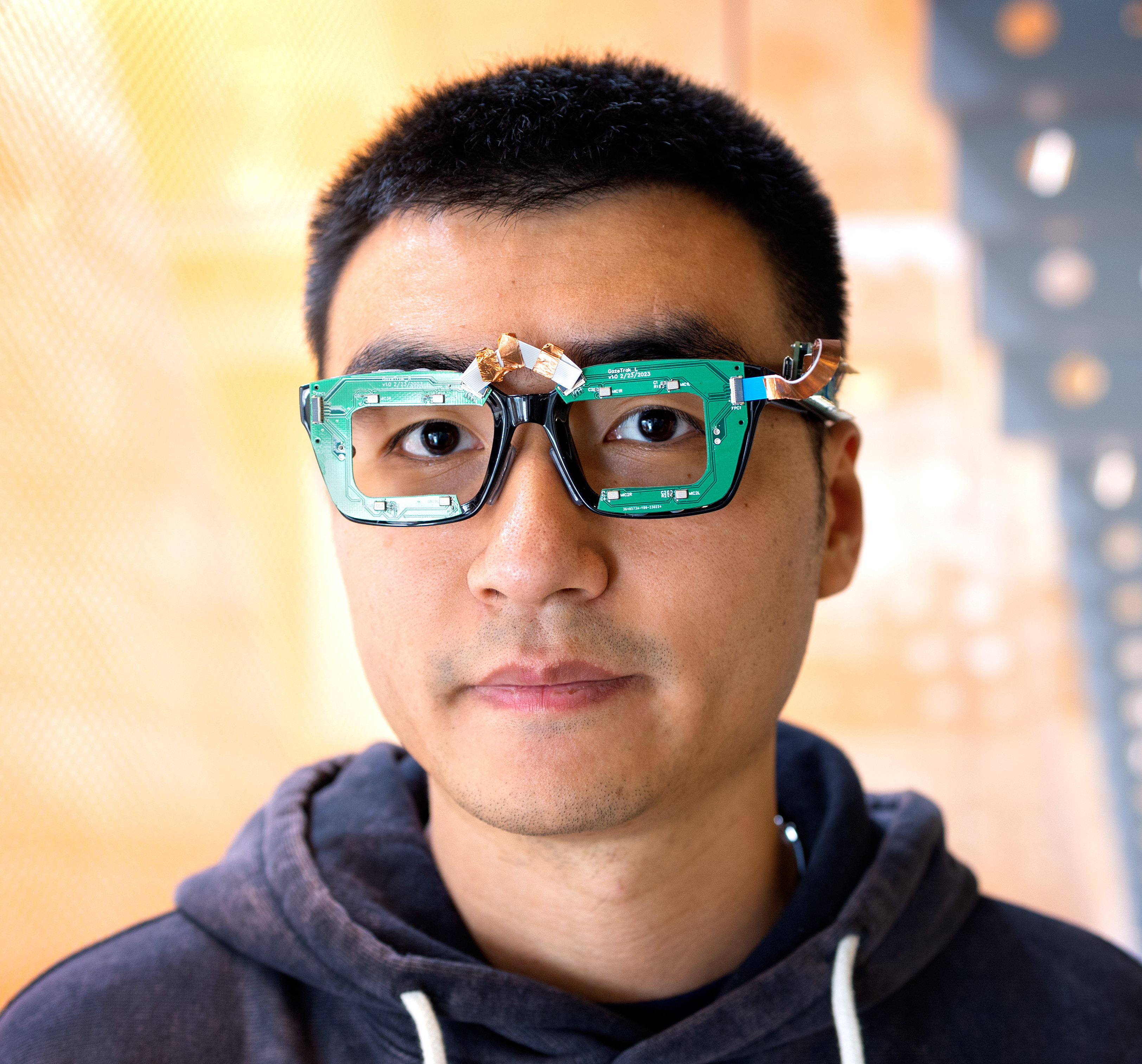
Facial paralysis (FP) is a debilitating condition affecting millions of people and approximately 98% of all FP cases are unilateral. Rapid and accurate quantification of facial asymmetries is an essential first step towards restoring symmetric facial movements for these patients. Researchers have developed computer-vision-enhanced programs to perform automated quantification of facial asymmetries. While powerful, they face challenges in mobile applications. This paper presents EMOTE (Echo-Measurement-of-Tracked-Expressions), a pair of AI-powered smart glasses based on active acoustic sensing to provide automated quantification of facial asymmetries for FP patients. In a user study with 22 FP patients, EMOTE-derived eFACE scores (a clinical facial grading system) were evaluated against expert clinician-graded scores for four dynamic facial metrics: oral commissure excursion, lower lip depression, eyebrow elevation, and eye palpebral fissure width. Method-comparison analyses showed strongest agreement for oral commissure excursion and average eFACE scores, moderate agreement for lower lip depression and eyebrow elevation, and weaker agreement for eye palpebral fissure width. EMOTE presents a portable technology to quantify facial asymmetries automatically and continuously. This technology could serve future patients by pacing real-time, closed-loop stimulation to reanimate the paralyzed face.